

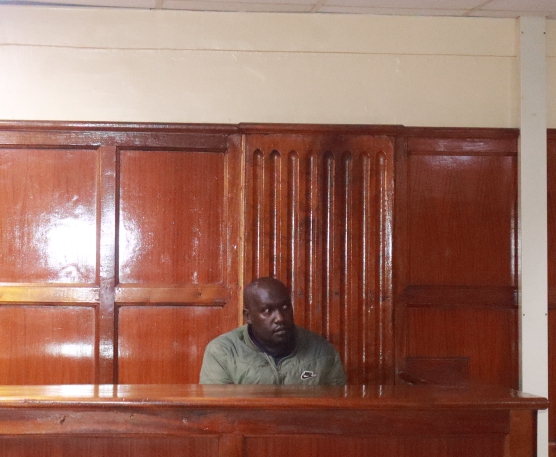
While appearing at Milimani Law Court on 5th May 2025, Albert Komen Kipkechem pleaded not guilty to all the charges. According to the charge sheet seen by Kauntinews.com, Komen, also known as Jonathan Kiptum, was charged with Access with Intent to Commit a Further Offence contrary to Section 15(1) and Computer Fraud contrary to Section 26(1)(b) as read with Section 2(a) of the Computer Misuse and Cybercrimes Act No. 5 of 2018.
Komen is believed to be the main suspect behind two incidents affecting a payment service provider, a local bank, and a SACCO, where the institutions lost over Ksh52 million in June 2025. Upon discovery of the fraud, the affected entities reported the matter to detectives from the Economic and Commercial Crimes Unit, attached to the Cyber Fusion Unit at the Central Bank of Kenya.
The detectives recorded their statements and immediately launched investigations.During investigations, it was established that the suspect was the mastermind behind the brazen heist. He allegedly used remote access software to gain unauthorized access to the payment platform and bank information systems, executing unauthorized transactions that did not follow the normal payment flow before the fraud was eventually detected.
After collecting relevant digital artifacts from the affected institutions and obtaining the necessary court orders and search warrants, detectives arrested Komen in Thome, within Nairobi County. He was then escorted to his Nakuru home, where several items linked to the fraud were recovered.Among the recoveries were electronic gadgets, fraudulently registered identity cards, a money counting machine, cash in Kenyan currency, assorted SIM cards from various telecommunications providers, and ATM cards registered under other people’s names. Also recovered were a Congolese passport bearing Komen’s photograph but registered under the name Katempa Ngoy Alexisa, and a Congolese identity card with the same name, among other items believed to have been used in the commission of the fraud.
The suspect was later escorted back to Nairobi and processed. While appearing in court, the prosecution asked that the court not release the accused on bond or bail. They cited the nature of the offenses involving sophisticated cross-border digital activities, which pose a high risk that Komen might abscond to avoid severe penalties if convicted.
The prosecution also pointed out that although Komen is a Kenyan citizen, he holds a Democratic Republic of Congo passport, making him a significant flight risk.The officer stated that investigations are ongoing into multiple other related incidents of computer fraud linked to the accused and releasing him would significantly prejudice these inquiries. Furthermore, Komen possesses technical expertise to remotely access, encrypt, or delete digital footprints and evidence crucial to the prosecution’s case.
At the time of his arrest on 2nd March 2026, he was found in possession of eight different National Identity Cards bearing his photograph but displaying different names and nationalities. The prosecution argued this demonstrated a calculated effort to conceal his true identity and highlighted a high propensity for deception.
They added that the existence of these fake identities makes it virtually impossible for the State to monitor his movements effectively, as he has the proven capacity to travel or conduct financial transactions under aliases.
In her ruling, the magistrate ordered that Komen be remanded at Capitol Hill Police Station until 12th March 2026, when the court will give directions regarding his bail and bond terms.